Thursday, 12 August 2010

Miroslav Klose Famous Footballer pics

Miroslav Klose Famous Football PlayersMiroslav Klose Famous Football Players

Miroslav Klose Top Germany StrikerMiroslav Klose Top Germany Striker

Miroslav Klose Celebrate GoalsMiroslav Klose Celebrate Goals

Thierry Henry Famous French Striker football player

Thierry Daniel Henry (born 17 August 1977)
Thierry Henry Famous French StrikerThierry Henry Famous French Striker

Thierry Henry Celebrate GoalsThierry Henry Celebrate Goals

Thierry Henry ImageThierry Henry Image

Sunday, 8 August 2010

real madrid players 2009-2010 champian team images

Surprising match in UEFA Champions League happen again. this time, it happen in the match Real Madrid versus AC Milan in Santiago Bernabeau, home base stadium of Real Madrid. Real Madrid that shown an impressive performance in Spanish La Liga and UCL' s matches before was beaten by AC Milan, 2-3 for AC Milan.

Before the match, Real Madrid FC was predicted will beat AC Milan easily. because AC Milan still play inconsistant performance in Italy Serie A. AC Milan often being beaten by an underdog football club in Serie A. even, AC Milan ever been beaten by Inter Milan with a big score, 4-0 for Inter Milan. AC Milan was also be beaten by FC Zurich in the match day before.

But in Santiago Bernabeau stadium, AC Milan has been shown a good performance by beating Real Madrid. I Rossoneri really has shown its class in UEFA Champions League. AC Milan's goals were made by Andrea Pirlo and Alexander Pato (two goals) while Raul Gonzales and Drenthe made a goal for Real Madrid, 2-3 for AC Milan. this score remained till the end of the match.
real madrid players 2009-2010 wallpaper
real madrid players pic
real madrid players
real madrid players 2009-2010 team
real madrid players 2009-2010 ronaldo

Friday, 6 August 2010

real madrid latest pictures

Real Madrid's origins go back to when football was introduced to Madrid by the academics and students of the Institución libre de enseñanza, which included several Oxbridge graduates. They founded Football Club Sky in 1897, playing on Sunday mornings at Moncloa. It split into two clubs in 1900: New Foot-Ball de Madrid and Club Español de Madrid. The latter club split again in 1902, resulting in the formation of Real Madrid Football Club on March 6 in 1902.[2] Three years after its foundation, in 1905, Madrid FC won its first title after defeating Athletic Bilbao in the Spanish Cup final. The club became one of the founding sides of the Royal Spanish Football Federation on 4 January 1909, when club president Adolfo Meléndez signed the foundation agreement of the Spanish FA. After moving between grounds the team moved to the Campo de O'Donnell in 1912.[5] In 1920, the club's name was changed to Real Madrid after King Alfonso XIII granted the title of Real (Royal) to the club.[6]

In 1929, the first Spanish football league was founded. Real Madrid led the first edition until the last match, a loss to Athletic Bilbao, meant they finished runners-up to Barcelona.[7] Real Madrid won its first League title in the 1931–32 season. The Whites won the League again the following year, becoming the first side to have won the championship twice.[8]

Santiago Bernabéu Yeste became president of Real Madrid in 1945.[9] Under his presidency, the club, the Santiago Bernabéu Stadium and the Ciudad Deportiva were rebuilt following the Spanish Civil War. Beginning in 1953, he embarked upon a strategy of signing world-class players from abroad, the most prominent of them being Alfredo di Stéfano.[10]

In 1955, acting upon the idea proposed by the French sports journalist and editor of L'Équipe Gabriel Hanot, and building upon the Copa Latina (a tournament involving clubs from France, Spain, Portugal and Italy), Bernabéu met in the Ambassador Hotel in Paris with Bedrignan and Gusztáv Sebes and created an exhibition tournament of invited teams from around Europe that would eventually become what today is known as the UEFA Champions League.[11] It was under Bernabéu's guidance that Real Madrid established itself as a major force in both Spanish and European football. The club won the European Cup five times in a row between 1956 and 1960, which included the 7–3 Hampden Park final against Eintracht Frankfurt in 1960.[10] Winning the competition five consecutive times saw Real permanently awarded the original cup and earning the right to wear the UEFA badge of honour.[12] The club won the European Cup for a sixth time in 1966 defeating FK Partizan 2–1 in the final with a team composed entirely of nationally born players (known as the Ye-yé team) – a first in the competition.[13] The name "Ye-yé" came from the "Yeah, yeah, yeah" chorus in the Beatles' song "She Loves You" after four members of the team posed for Diario Marca dressed in Beatles wigs. The Ye-yé generation was also European Cup runner-up in 1962 and 1964.[13]

In the 1970s, Real Madrid won 5 league championships and 3 Spanish Cups.[14] The club played its first UEFA Cup Winners' Cup final in 1971, being defeated by English side Chelsea 2-1.[15] On 2 July 1978, club president Santiago Bernabéu died while the World Cup was being played in Argentina. In his honour FIFA decreed three days of mourning during the tournament.[16] The following year, the club organized the first edition of the Santiago Bernabéu Trophy in the memory of its former president.

By the early 1980s, Real Madrid had lost its grasp on the La Liga title until a new batch of home-grown stars brought domestic success back to the club.[17] Spanish sport journalist Julio César Iglesias gave to this generation the name La Quinta del Buitre ("Vulture's Cohort"), which was derived from the nickname given to one of its members, Emilio Butragueño. The other four members were Manuel Sanchís, Martín Vázquez, Míchel and Miguel Pardeza.[18] With La Quinta del Buitre (reduced to four members when Pardeza left the club for Zaragoza in 1986) and notable players like goalkeeper Francisco Buyo, right-back Miguel Porlán Chendo and Mexican striker Hugo Sánchez, Real Madrid had one of the best teams in Spain and Europe during the second half of the 1980s, winning two UEFA Cups, five Spanish championships in a row, one Spanish cup and three Spanish Super Cups.[18]

In the early 1990s, La Quinta del Buitre split up after Martín Vázquez, Emilio Butragueño and Míchel left the club. In 1996, President Lorenzo Sanz appointed Fabio Capello as coach. Although his tenure lasted only one season, Real Madrid was proclaimed league champion and players like Roberto Carlos, Predrag Mijatović, Davor Šuker and Clarence Seedorf arrived at the club to strengthen a squad that already boasted the likes of Raúl, Fernando Hierro, Iván Zamorano, and Fernando Redondo. As a result, Real Madrid (with the addition of Fernando Morientes in 1997) finally ended its 32-year wait for its seventh European Cup. In 1998, under manager Jupp Heynckes, The Whites defeated Juventus 1–0 in the final thanks to a goal from Predrag Mijatović.[19]

In July 2000, Florentino Pérez was elected club president.[20] His campaign vowed to erase the club's debt and modernize the club's facilities. However, the primary electoral promise that propelled Pérez to victory was the signing of Luís Figo.[21] The following year, the club controversially got its training ground rezoned and used the money to begin assembling the famous Galáctico side including players such as Zinédine Zidane, Ronaldo, Luís Figo, Roberto Carlos, Raúl and David Beckham. It is debatable whether the gamble paid off, as despite a European Cup win in 2002, followed by the League in 2003, the club failed to win a major trophy for the next three seasons.[22]

Ramón Calderón was elected as club president on 2 July 2006 and subsequently appointed Fabio Capello as the new coach and Predrag Mijatović as the new sporting director. Real Madrid won the La Liga title in 2007 for the first time in four years but Capello was sacked.[23] In the 2007–08 season, The Whites won the domestic league for the 31st time, achieving their first consecutive league title in eighteen years.[24] On 1 June 2009, Florentino Pérez regained Real Madrid's presidency.[25][26] Pérez continued with the Galácticos policy pursued in his first term, buying Kaká from A.C. Milan[27] then purchasing Cristiano Ronaldo from Manchester United for a record breaking £80 million.
real madrid image
real madrid wallpaper
real madrid
real madrid pic
real madrid

Tuesday, 3 August 2010

football lig players images

Tonight’s action: Liverpool V Inter Milan Olympiakos V Chelsea Roma V Real Madrid Shalke 04 V FC Porto V The pick of the ties comes at Anfield where Liverpool and Inter lock horns for the first time since their controversial 1965 European Cup semi-final where the Merseysiders took a 3-1 advantage into a second leg [...]
football lig
football lig
football lig
football lig
football lig
The draws for Europe’s premier competitions have been made and there are some mouth-watering ties in prospect. In the Champions League, European champions AC Milan will face Premiership leaders Arsenal in the pick of the ties. Arsenal and AC Milan play some of the best football around and the idea of the two clashing is a most

Monday, 2 August 2010

Zico football wallpapers

After the 2002 FIFA World Cup, Japan Football Association looked for a replacement for the outgoing Philippe Troussier, and chose Zico as his successor. Despite his lack of coaching experience besides his stint as Brazil's technical coordinator during the 1998 World Cup, Zico had great understanding of Japanese soccer from his playing days and his role as Kashima's technical director. In addition, JFA had grown tired of Troussier's clashes with the media while the players were frustrated with his micromanagement. In contrast, Zico commanded respect from reporters and urged players to express themselves on the pitch.[17]

Although Zico attempted to instill a free-flowing, attacking mentality to the team, his regime got off to an uneven start, which included a 4-1 loss to Argentina in 2003. Japan had a respectable showing at that year's Confederations Cup but struggled again in the beginning of 2004, only narrowly beating Oman in the first stage of qualifying for the 2006 FIFA World Cup and several players were suspended after a drinking incident.[18] Although Japan had not lost in its nine previous matches, he was rumored to be on the verge of resigning and a small group of fans marched in the streets of Tokyo demanding his firing.[19]

He stayed on, however, and won the 2004 Asian Cup despite intimidation from Chinese fans and a team that featured just one European-based player, Shunsuke Nakamura.[20] He then helped Japan qualify for the 2006 FIFA World Cup with just one loss.

Despite the rocky start, injuries to key players and even a bizarre offer from Garforth Town,[21] Zico has led Japan to its third World Cup finals appearance and the third Asian Cup title in four tries. His Japanese team is heavily influenced by Brazil's short passing style, but he has been flexible enough to switch between 4-4-2 and 3-5-2 formations. In addition, he has had a respectable record on European soil, beating Czech Republic and Greece and drawing with England, Brazil and most recently Germany.

However, Japan failed to win a single match at the Finals, losing twice (to Australia and Brazil) and drawing once (to Croatia), and scoring just two goals while conceding seven. He resigned from Japan at the end of the World Cup campaign.
[edit] Fenerbahçe

In July 2006, signed a two-year deal with Fenerbahçe.[22] He won the league title in 2007 and won Turkish Super Cup on the first year of his job. Under his command Fenerbahce has qualified from UEFA Champions League 2007-08 groups stage for the first time of club's history and beat Sevilla FC to become a quarter-finalist in 2007-08 season. So far, he also is the team's most successful manager in the history of the European arena.

Zico was given a new nickname by Fenerbahçe fans: Kral Arthur (meaning "King Arthur" in Turkish). For the team's nickname King Arthur and his Knights. In a chat hosted by uefa.com he pointed out that it is unlikely he will sign a contract extension with Fenerbahçe. This was confirmed on 10 June 2008 when he resigned as Fenerbahce manager.

On 8 September 2008, Zico revealed that he would be interested taking over the vacant managers position at Newcastle United following the resignation of Kevin Keegan. He is quoted saying "The Newcastle job is one that I would be very interested in taking. It would be a privilege and an honour, I've always wanted to experience the Premier League as I believe I could enjoy much success coaching in England." He also commented that he isn't bothered about the structure of the board at Newcastle United, "I am used to working alongside technical directors so this isn't an issue for me. It's normal for me to work in those conditions."
[edit] Bunyodkor, CSKA Moscow and Olympiakos C.F.P

In 2008, he coached FC Bunyodkor in Uzbekistan, where he won the Uzbekistani Cup and the Uzbek League. He subsequently took over at Russian side CSKA Moscow but was fired on 10 September 2009.

Less than a week later Zico signed a 2-year contract with Olympiacos F.C.[23][24]. Despite the absence of numerous first-team players due to injuries, he led the Greek club to a comfortable 2nd place in Group H of the Champions League, earning the qualification to the knockout stage. In the Greek Superleague his first results were also impressive, but the success lasted only till early winter and the fans started to complain about both the results and the playing style of the team.[25] And they were ready to use violence against him (or his team) in order to achieve their ends.[26] Finally on January 19, 2010, after a negative series of 4 matches with just one win, though his team lost only two times (twelve wins and four draws) in the Greek Superleague, Zico was sacked[27].
[edit] Back to Flamengo

On May 30th of 2010, Zico announced that he would become the new Soccer Executive/Director for Flamengo, coming back to the team where he won his most important honors after 25 years. One of his demands is that his salary won't be paid by the club. Instead, it will be paid by Flamengo's sponsors such as Olympikus and BMG. His contract is for four years.
Zicokick
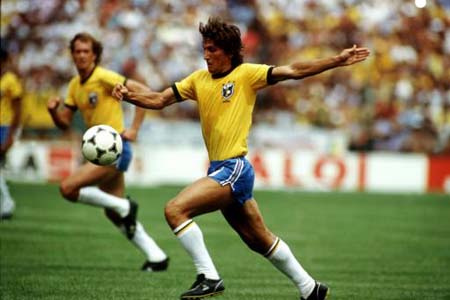
Zico
Zico and ronaldo
Zico barazllian
Zico moto

Zico football players

Zico came from a lower-middle-class family, in the neighborhood of Quintino, Rio de Janeiro. In common with many Brazilians, he spent much of his youth dreaming of playing professional football. In 1967, while still a teenager, he had a scheduled trial at América, where his brothers Antunes and Edu were playing at the time. But he caught the attention of the radio reporter and friend, Celso Garcia, who asked Zico's father to take him to a trial at Flamengo instead. Being a fan of Flamengo, Zico had his father's approval, beginning his path towards becoming one of the most admired players in the history of the sport.
[edit] Flamengo

Physically Zico was not strong, and his history of determination and discipline began with a hard muscle and body development program conducted by the Physical Education teacher José Roberto Francalacci. A combination of hard work and also a special diet sponsored by his team enabled him to develop a strong body and become an athlete. This later proved to be essential for his success.[7]

In 1971, he had some appearances in the professional team but only one year later, after 116 matches and 81 goals in the youth team, Zico was promoted to Flamengo's professional squad.

While at Flamengo, Zico was a key player during the most glorious period of the team's history. Along with many other titles, in his first period at Flamengo he led the team to victory in the 1981 Copa Libertadores, the 1981 Intercontinental Cup, and four national titles (1980/82/83/87). On the field, Zico made goals in all imaginable ways, was also a great assister and team organizer, and was known for his excellent vision of the field. He was a two-footed player and an expert at free kicks.[5]

In the 1978 World Cup against Sweden, Zico headed a corner kick into the goal in the final minute of the match, apparently breaking a 1-1 tie. However, in a call that became infamous, the Welsh referee Clive Thomas disallowed the goal, saying that he had blown the whistle to end the match while the ball was still in the air.[8]

1982 World Cup would see Zico as part of a fantastic squad, side by side with Falcão, Sócrates, Cerezo and Júnior. In spite of his 4 goals and great skills by that squad, the team was defeated by Paolo Rossi and Italy in the second round.
[edit] Italy

After receiving offers from AS Roma and AC Milan, it seemed right to move to Italy, and in a multi-million dollar transaction he was hired to play for Udinese Calcio. Though leaving Flamengo fans in sadness, he caused a commotion in Udine by making fans to dream about better days for the city's club. In the 1983-84 Serie A, his first in Italy, his partnership with Franco Causio took Udinese to a higher level, gaining respect from giants Juventus and Roma. His personal top scorer dispute against Juventus's Michel Platini was exciting — Zico scored 19 goals, one less than top scorer Platini, having played 6 matches less than the French footballer. His following season would be punctuated by injuries, suspensions due to openly attacking referees, and a great match against Napoli's Diego Maradona -- his last one as a bianconero.

Ultimately Udinese failed to win any relevant competition and Zico returned to Brazil and Flamengo, sponsored by a group of companies.
[edit] Back to Brazil

On his return, he suffered a knee injury after a violent tackle from Bangu's defender Marcio Nunes, which interrupted his career for several months. He played in the 1986 FIFA World Cup while still injured, and missed a penalty during regular time in the quarter-final match against France. The match ended in a tie which led to a shootout. Zico then scored his goal but after penalties missed by Sócrates and Júlio César, Brazil were knocked out. Recovered from injuries, things improved for Zico in 1987 when he led Flamengo to their fourth national title.[9]

In December 1989 Zico made his last official appearance for Flamengo in a Brazilian National Championship match against rivals Fluminense. Zico made the first goal and Flamengo won the match 5-0[10].

Two months later, he would play his last match as a Flamengo player facing a World Cup Masters team composed of names like Eric Gerets, Claudio Gentile, Franco Causio, Alberto Tarantini, Jorge Valdano, Mario Kempes, Paul Breitner, Karl-Heinz Rummenigge and Falcão.[11]

With 731 matches for Flamengo, Zico is the player with the 2nd most appearances for the club. His 508 goals make him the club's top scorer ever.

The achievements of the greatest idol in Flamengo's history[12][13] inspired the Brazilian singer Jorge Benjor to write a song in his honour - Camisa 10 da Gávea - helping create the mystique of the club's number 10.

Zico also represented Brazil in the World Cup of Masters, scoring in the final of the 1990 and 1991 editions.
[edit] Brief retirement

After Brazil's first presidential election in many years, the new president Fernando Collor de Mello appointed Zico as his Minister of Sports. Zico stayed at this political assignment for about a year and his most important contribution was a piece of legislation dealing with the business side of sport teams.
[edit] Japan

In 1991, Zico interrupted his political assignment when he accepted an offer to join the Sumitomo Metal Industries Soccer Club in Kashima, Ibaraki Prefecture, to help the club secure a place in Japan's first fully professional soccer league that was set to officially launch in 1993 — J. League. Zico played for Sumitomo in 1992, the last season before the old Japan Soccer League was disbanded, and finished as the league's top scorer. When the new league launched, the small town club, renamed Kashima Antlers, was not expected to compete with richer, more glamorous clubs like Yokohama Marinos and Verdy Kawasaki. Zico, however, helped the Antlers to win the J.League Suntory Series and a runners-up finish in its inaugural season, leading the club to cement its place among the league's elite.

His discipline, talent and professionalism meshed very well with Japanese culture, and his influence earned him the nickname, "God of Soccer" (サッカーの神様, sakkā no kamisama?) from Japanese soccer fans.[14]
[edit] Retirement, Beach Soccer and CFZ

Zico retired from professional football during the 1994 season but received an invitation to play Beach Soccer. He returned to Kashima to become the Antlers' technical adviser in 1995, splitting his time between Japan and Brazil - where he still managed to find time to play Beach Soccer. One year later, in 1996, he founded CFZ (Zico Football Centre) in Rio de Janeiro. Zico founded another club, named CFZ de Brasília, in 1999. By this time, he was a local legend in Japan for having built a contender from almost nothing and putting the city of Kashima on the map. A statue in his honor stands outside Kashima Stadium
Zico
Zico
Zico football player
Zico football
Zico football player