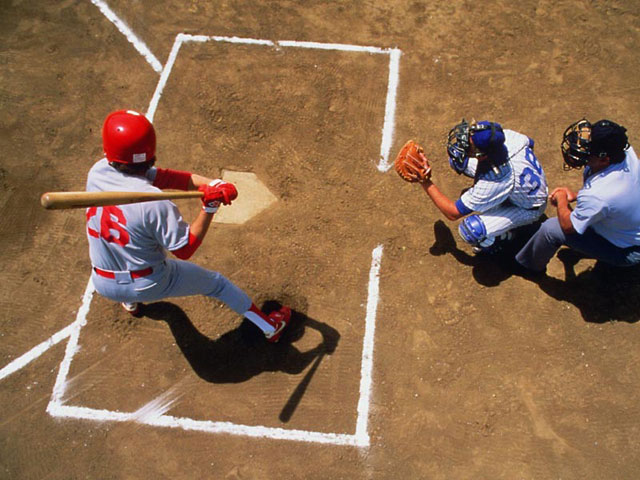
Americans began playing baseball on informal teams, using local rules, in the early 1800s. By the 1860s, the sport, unrivaled in popularity, was being described as America's "national pastime."
Alexander Joy Cartwright (1820-1892) of New York invented the modern baseball field in 1845. Alexander Cartwright and the members of his New York Knickerbocker Base Ball Club, devised the first rules and regulations for the modern game of baseball.
Baseball was based on the English game of rounders. Rounders become popular in the United States in the early 19th century, where the game was called "townball", "base", or "baseball". Cartwright formalized the modern rules of baseball.
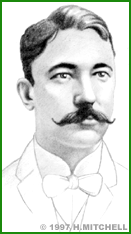
Alexander Joy Cartwright
The first recorded baseball game in 1846 when Alexander Cartwright's Knickerbockers lost to the New York Baseball Club. The game was held at the Elysian Fields, in Hoboken, New Jersey. In 1858, the National Association of Base Ball Players, the first organized baseball league was formed.
Surprisingly little is known about the origin of baseball. The question has been the subject of considerable debate and controversy for more than 100 years. Baseball (and softball), as well as the other modern bat, ball and running games, cricket and rounders, developed from earlier folk games, many of which were similar to each other, but there were certainly local, regional and national variations, both in how they were played and what they were called, such as stoolball, poison ball, and goal ball. Few details of how the modern games developed from earlier folk games are known. Some think that various folk games resulted in a game called town ball from which baseball was eventually born.
A number of early folk games in England had characteristics that can be seen in modern baseball (as well as in cricket and rounders). Many of these early games involved a ball that was thrown at a target while an opposing player defended the target by attempting to hit the ball away. If the batter successfully hit the ball, he could attempt to score points by running between bases while fielders would attempt to catch or retrieve the ball and put the runner out in some way.
Since they were folk games, the early games had no 'official' rules, and they tended to change over time. To the extent that there were rules, they were generally simple and were not written down. There were many local variations, and varied names.
Many of the early games were not well documented, first, because they were generally peasant games (and perhaps children's games, as well); and second, because they were often discouraged, and sometimes even prohibited, either by the church or by the state, or both.
Aside from obvious differences in terminology, the games differed in the equipment used (ball, bat, club, target, etc., which were usually just whatever was available), the way in which the ball is thrown, the method of scoring, the method of making outs, the layout of the field and the number of players involved.
An old English game called "base," described by George Ewing at Valley Forge, was apparently not much like baseball. There was no bat and no ball involved! The game was more like a fancy game of "tag", although it did share the concept of places of safety (ie, bases) with modern baseball.
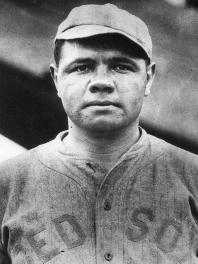
Babe Ruth
In an 1801 book entitled The Sports and Pastimes of the People of England, Joseph Strutt claimed to have shown that baseball-like games can be traced back to the 14th century, and that baseball is a descendant of a British game called stoolball. The earliest known reference to stoolball is in a 1330 poem by William Pagula, who recommended to priests that the game be forbidden within churchyards.
In stoolball, a batter stood before a target, perhaps an upturned stool, while another player pitched a ball to the batter. If the batter hit the ball (with a bat or his/her hand) and it was caught by a fielder, the batter was out. If the pitched ball hit a stool leg, the batter was out. It was more often played by young men and women as a sort of spin the bottle.
According to many sources, in 1700, a Puritan leader of southern England, Thomas Wilson, expressed his disapproval of "Morris-dancing, cudgel-playing, baseball and cricket" occurring on Sundays. However, David Block, in Baseball Before We Knew It, reports that the original source has "stoolball" for "baseball". Block also reports that the reference appears to date to 1672, rather than 1700.

A 1744 publication in England by John Newbery called A Little Pretty Pocket-Book includes a woodcut of stoolball and a rhyme entitled "Base-ball." The book was later published in Colonial America in 1762. In 1748, the family of Frederick, Prince of Wales partook in the playing of a baseball-like game. A 1791 bylaw in Pittsfield, Massachusetts bans the playing of baseball within 80 yards of the town meeting house.
Les Jeux des Jeunes Garçons is the first known book to contain printed rules of a bat/base/running game. It was printed in Paris, France in 1810 and lays out the rules for "poison ball," in which there were two teams of eight to ten players, four bases (one called home), a pitcher, a batter, and flyball outs.
Another early print reference is Jane Austen's posthumous 1818 novel Northanger Abbey.
In 1829, William Clarke in London, published The Boy’s Own Book which included rules of rounders. Similar rules were published in Boston, Massachusetts in 1834, except the Boston version called the game "Base" or "Goal ball." The rules were identical to those of poison ball, but also added fair and foul balls and strike outs.
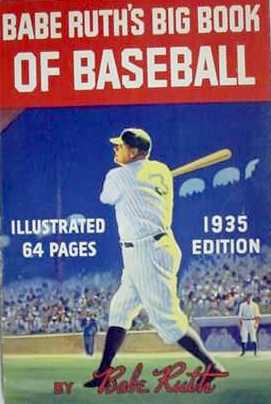
Babe Ruth's Big Book of Baseball
-
1845: Alexander Cartwright published a set of baseball rules for the Knickerbocker Club of New York, and his rules were widely adopted.
-
1869: The Cincinnati Red Stockings became the first openly-salaried team and are thus considered the first professional team.
-
1871: The first professional baseball league, the National Association of Professional Base Ball Players, was established.
-
1876: The first major league, the National League, was formed.
-
1878: Frederick Winthrop Thayer of Massachusetts (captain of the Harvard University Baseball Club) received a patent for a baseball catcher's mask on February 12.
Alexander Joy Cartwright (1820-1892)
Baseball, like the United States, evolved out of a British precedent into a unique and independent institution. The origin of American baseball lies in an informal offshoot of the English sport of cricket called "rounders," played in the Colonies as early as the mid-18th century. The game was already called "base-ball" in a children's book of 1744. Essentially, a batter had to hit a pitched ball and then run the bases (from one to five of them) without being tagged or "plugged"---hit by a ball thrown by one of the fielders.
A special Commission of 1907 concluded that baseball had been "invented" by the Civil War hero Abner Doubleday (1819-1893), in Cooperstown, New York, in 1839. But it was actually Alexander Joy Cartwright (1820-1892) of New York who established the modern baseball field (1845). In Cartwright's rules of play, however, plugging was allowed; a ball fielded on one bounce was an out; pitching was underhand; and the game was won by the first team to score 21 "aces" (runs), in however many innings.
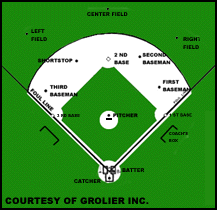
Cartwright Baseball Pitch
By this time, baseball had become a leisure activity for wealthy young men. But later, after Civil War soldiers who had played baseball behind the lines brought the game back to their hometowns, baseball was both watched and played by Americans of every social status.
Baseball was institutionalized and further developed by the National Association in 1858. The Cincinnati Red Stockings became the first all-professional team in 1869. The rival National (1876) and American (1903) Leagues competed in the first World Series in 1903 and All-Star Game in 1933. In 1947, the Brooklyn Dodgers signed Jackie Robinson, removing the color barrier that had consigned black players to the "Negro Leagues."
Since then, baseball has continued to embrace ever more players and fans---of all ages, both sexes, and various backgrounds---here and world-wide (especially in Central America and Japan). Today, despite the disillusioning Major League strike of 1994-95, baseball remains unchallenged as the quintessential American pastime.
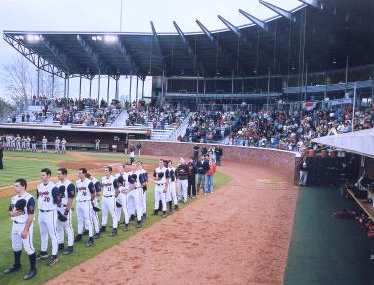
Baseball Stadium Virginia USA
1845 / The Knickerbocker Rules
The first published rules of modern baseball were written in 1845 for a Manhattan team called the Knickerbockers. The author of those rules, Alexander Cartwright, has come to be known as the father of modern baseball. The evolution of the so-called "Knickerbocker Rules" into the rules of today is fairly well documented. The role of Cartwright himself has been alleged by some baseball historians to be significantly exaggerated, a modern attempt similar to the Doubleday story, to try to pinpoint a single "inventor" of the game, albeit with at least some measure of substantiation. One factor that is undisputed by historians is the direct evolution from the amateur urban teams (not the Cooperstowns of America) of the 1840s to the modern professional major leagues which began in the 1870s.
Before 1845
The evolution of the game which became modern baseball prior to 1845 is unclear. The Knickerbocker Rules describe a game that people had been playing for some time. But exactly how long is uncertain, as is the question of how that game developed.
Early theorists tended to fall into two camps. One group, mostly English, asserted that baseball evolved from a game of English origin (probably rounders), while the other group, almost entirely American, argued that baseball was an American invention (perhaps derived from the game of one ol' cat). Proponents of these two views apparently saw them as mutually exclusive. Some of their conclusions seem based more on a sense of national loyalty than on any actual evidence.
American historians tended to reject any suggestion that baseball evolved from an English game, while some English observers concluded that baseball was little more than rounders without the round. The theory that baseball is based on English games (such as cat, cricket and rounders) is difficult to dispute. On the other hand, baseball has many elements that are uniquely American.
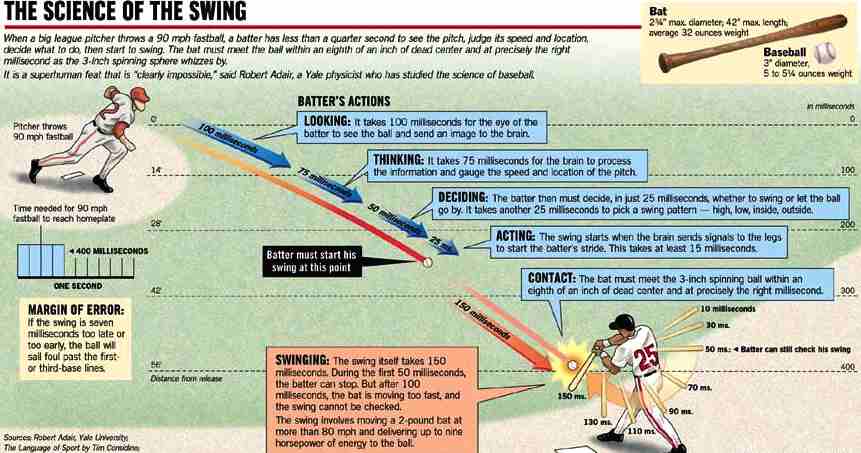
Baseball swing technique
Cricket and Rounders
Baseball is almost certainly related to cricket and rounders, but exactly how, or how closely, has not been established. The theory that baseball is derived from cricket is difficult to document, although it is certainly true that modern cricket is considerably older than modern baseball.
People have been playing games with ball and stick for centuries. These various bat-and-ball games are all, at the very least, cousins to each other. Although there are many specific differences between the games, in general they all involve throwing a ball to a batsman who attempts to hit it and run to a goal of some kind.
After 1845
In 1857, 25 Northeastern clubs sent delegates and standardized the rules. In 1858, they formed the first baseball league, the National Association of Base Ball Players. The league started giving games to the public and charged an admission.
During the American Civil War, soldiers from the Northeast, where baseball was flourishing, spread the game all over the country. After the war ended, baseball had more than 100 clubs.
In 1869, the world's first openly professional baseball team formed. All previous players were at least theoretically amateur and unpaid. The Cincinnati Red Stockings recruited the best players and no one beat the Red Stockings that year.
Regardless of this and later changes, several clubs exist in the present-day United States that play "the old game", either according to the 1845, 1858, or post-Civil War rules.
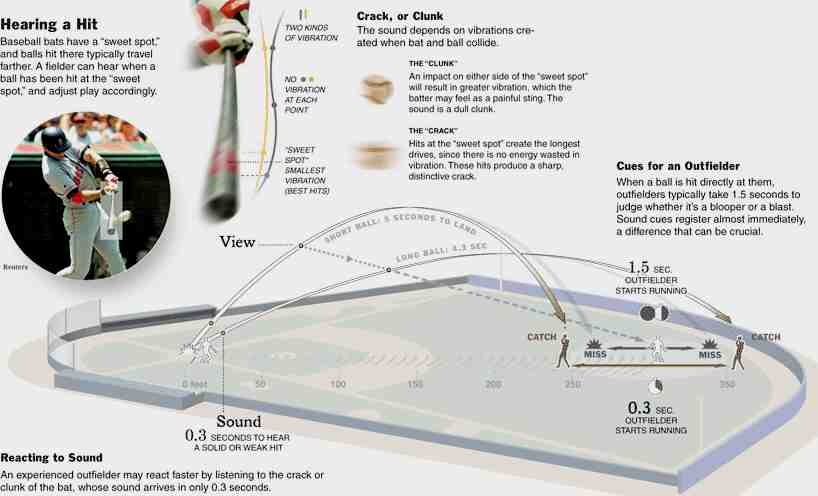
The sound of a good hit - the crack
Stoolball
Origins of Stoolball:
1) In stoolball, which developed by the 11th century, one player throws the ball at a target while another player defends the target. Stob-ball and stow-ball were regional games similar to stoolball.
In stob ball and stow ball the target was probably a tree stump, since both "stob" and "stow" mean stump in some dialects. ( "Stow" could also refer to a type of frame used in mining). What the target originally was in stoolball is not certain. It could have been a stump, since “stool” in old Sussex dialect means stump.
2) According to one legend, milkmaids played stoolball while waiting for their husbands to return from the fields. Another theory is that stoolball developed as a game played after attending church services, in which case the target was probably a church stool.
Originally, the stool was defended with a bare hand. Later, a bat of some kind was used (in modern stoolball, a bat like a very heavy ping-pong paddle is used).
Clear regional variation:
There were several versions of stoolball. In the earliest versions, the object was primarily to defend the stool. Successfully defending the stool counted for one point, and the batter was out if the ball hit the stool. There was no running involved. Another version of stoolball involved running between two stools, and scoring was similar to the scoring in cricket. In perhaps yet another version there were several stools, and points were scored by running around them as in baseball.
Because of the different versions of stoolball, and because it was played not only in England, but also in colonial America, stoolball is considered by many to have been the basis of not only cricket, but both baseball and rounders as well.
THE BASEBALL BAT
The game of Baseball has had to evolve with the times and meet the demands and interest of fans. Drawing more fans, means more money. Fans are drawn with a tougher offense. Thus the game has evolved to meet the need for more offense. The evolution of baseball begins with the development of the baseball bat.
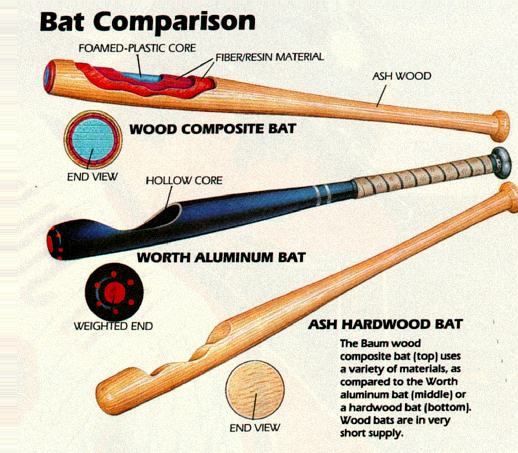
Baseball bat development
Bats come in various widths, lengths and materials. Naturally, a heavier bat will give more momentum to the ball. However, a heavier bat means less speed in the swing. A lighter bat will give the batter more control but less momentum. The restitution of a bat (the relationship with the "bounciness" of an object) also determines how far a ball will travel. Bats made out of aluminum or graphite hit balls farther than bats made of wood.
In the 1970's, aluminum bats were first used. Batting averages rose 30 points and the number of homeruns hit doubled. Now, Major League batters use wooden bats. If they changed to a lighter material such as aluminum, there would be more homeruns hit and the traditional records and baseball legends would seem insignificant.
Because different leagues (major, minor and amateur) use different types of bats, the transition to different leagues was difficult. A bat was needed to aid players in the adjustment from each league. Designers wanted the features of hardwood bats and the light weight of aluminum bats. In 1991, Steven Baum, a mechanical engineer created the "Baum Bat".
The Baum Bat was made of high strength inner core made from resin impregnated fibers and yarns with an ashwood surface. It looked, felt and functioned as a wooden bat but was much more durable. The Baum Bat improved hitting power by 5%.
Balls have also been restructured to travel farther and the pitchers mound has been moved back. Changes in materials and designs of equipment have brought an overall increase to the offense and the game has evolved to give fans a more exciting game.
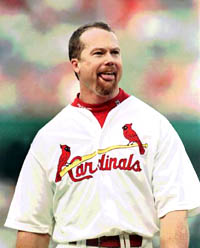
Mark McGwire
BASEBALL LINKS:
1918: Babe Ruth and the World Champion Boston Red Sox
1919 Black Sox
All-Time League Leadership Rankings
Ballplayers and the Armed Forces
Baseball Almanac - Baseball Almanac has more than 24,000 pages of baseball records, statistics, quotations, legendary lists, fabulous feats, autographs, box scores, famous firsts, ballparks, and awards.
The Baseball Encyclopedia During World War II
Baseball Generations
Baseball History in Mission City, B.C.
Baseball History on the Web
Baseball History: 19th Century Baseball
Baseball in New Orleans
Baseball in the 1990's
Baseball in Utica, N.Y.
The Baseball Index SABR
Baseball Reliquary
Baseball: History and Spirit
CBA for Fans
Cranks, Rooters & Fans of The Woodlands - Business and social event center, vintage base ball autograph and memorabilia shop in a museum-like setting. Located in The Woodlands, Texas (Oak Ridge North).
Doc Lawson's Vintage Base Ball Page
Encyclopedia of Baseball Catchers
Fort Myers Baseball History
Freight Train's Vintage Base Ball Website
Game Six: 1975 World Series
Glory Days: Baseball in NY 1947-1957 Fee required.
Graphical History of Baseball Michael Bein
Greater Mercer County Baseball
Greatest Baseball Teams of All Time
The Hall-Ruggles Chapter of SABR in Dallas-Fort Worth
HaroldSeymour.com
Hartford Vintage Base Ball Invitational
Historic Baseball Baseball Obituaries for 2001, 2002. Player and Team profiles. South Carolina players in the Majors.
Historical Hot Stove
History 335: American Baseball History Belmont University
The House of David Baseball Team Research Project
Infoplease Baseball Almanac
Law, Politics & the National Pastime
Major League Baseball's Best Of All Time
The Mendoza Line
Minnesota Baseball Glory Days
Minor League History About.com
Minor League Researcher
Mr. Baseball
National Baseball Hall of Fame and Museum
National Pastime Baseball History
NetShrine - Baseball's Best
NINE: A Journal of Baseball History and Culture
Nineteenth-Century Base Ball Pictures on the World Wide Web
Nisei Baseball Research Project
Old Time Boston Baseball & World Series News
Old Timers' Baseball Assn. of Chicago
OldBallGame
Personal Web Page di Stefano Quaino
Pre-World War Two Hall of Famers
Professional Baseball Franchise Histories
SABR's Top 100 Players of the 20th Century Baseball Weekly
Seattle's Baseball History
Society for American Baseball Research (SABR)
Society for American Baseball Research UK
Soxsuck.com
SteveSteinberg.Net
Subway Series
The Sweet Summer of Orie Arntzen
This Great Game
Today in Baseball History
Two Old Ballgames
Tyler, Texas Minor League History
The Unofficial 1927 New York Yankees Home Page
Vintage Base Ball Association
Vintage Base Ball Images
When It Was A Game.net
Wilmington Baseball History
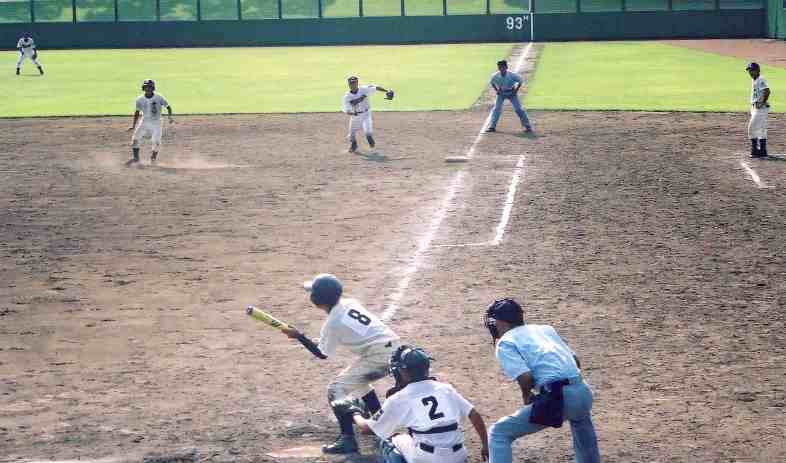
Baseball a game to be enjoyed
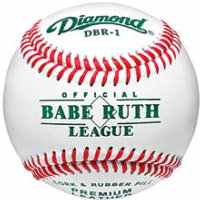
Babe Ruth League - Diamond Sports Ball